All eyes will be on the RBA following their June meeting after deciding to hold interest rate steady in May. We can gather that the reason to hold interest rates behind the May meeting are driven predominately by a number of mix economic signals and the upcoming Federal election. With the election completed, the additional data points will be crucial in pushing the RBA to either cut rates or hold them steady.
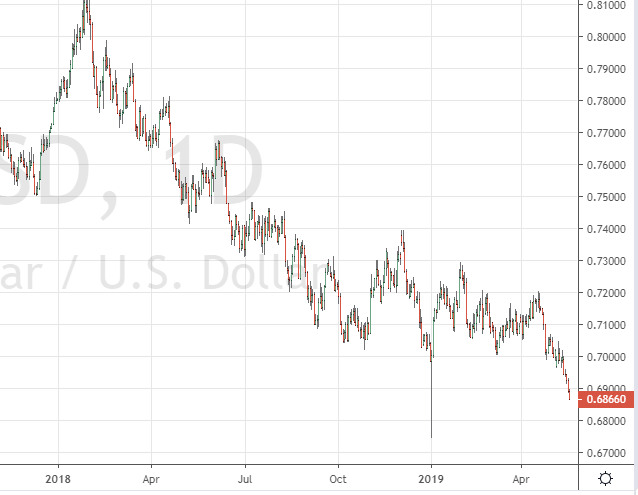
The most recent peak in the currency was at the start of 2018 and has been in a down trend ever since until the Federal election. The depreciation from 80 to 69 cents per USD reflect the inversion of the interest rate swap curve which has been pricing in a number of interest rate cuts for 2019.
AUD/USD FX Rate
These are the key indicators to keep an eye on which will likely drive the interest rate decision in June
Indicator 1: Australia Employment Data
RBA will be keeping an eye on the labour market and will be sensitive to any deterioration in the jobs market. So far the data has been supportive with the increase in participation rate doing the heavy lifting keeping the market healthy. This is will be the key driver of the interest rate decision as any decrease in job numbers will put pressure for them to act.
Indicator 2: Consumer Price Index
The CPI is the second most powerful indicator in driving the interest rate decision aside from employment data. Weak CPI data provides cover for RBA to cut rates. Any strong CPI data will severely reduce chances of rate cut. Good thing is the current CPI is weak with no material expectation of increase in the near future.
Indicator 3: Residential Housing Market
The continual weakness in housing market while not helping consumer sentiment which provides headroom for RBA to reduce interest rates. The end of the Federal election provides some degree of policy certainty and impetus for activity in the market. This however will take time to flow through in the data as the transaction lifecycle for real estate deals are always longer than financial deals.
Indicator 4: US and China Trade War
The economic backdrop of the US/China trade war is not helping market sentiment. Australia will be the collateral damage with China and US being two of Australia’s largest trading partner. Any deterioration in either economy will have negative flow on effects and it will likely to put a lid on growth for the immediate future. The failure by both parties to secure a trade deal in May 2019 means that the negotiations will not be completed anytime soon (if ever) which will continue to add uncertainty/volatility to the market.
Indicator 5: Financial Conditions
The key obstacle to any rate cut will be the marginal benefit of 25bps cut from current level verses the increase in the risk of financial excess from a loosened financial conditions. Any cuts in interest rate will put bank profitability under pressure, which makeup a material component of the ASX index and could pose wider risk to the broader economy. They would be looking at what is current happening to European banks since the GFC after the ECB keeping the European interest rates extremely low for a prolonged period. Aside from the banks, low interest rates also poses risks to financial companies such as Challenger.
The common theme from the above indicators are that whilst they are weak and have come off their cyclical highs. They are not recession level yet. For RBA to act decisively, the numbers has to get worse before better and this could mean more pain before any meaningful indication from the reserve bank that they will cut the interest rate.